
France receives more international visitors than any other country in the world — over 100 million in a normal year — yet the visa price question is one that catches a surprising number of applicants unprepared. The standard Schengen short-stay visa for France costs €90 for adults in 2026, a figure that has been in place since June 2024 when the EU revised its Schengen Visa Code fee structure upward. But €90 is rarely all you pay. The total realistic cost of a France visa application for most international visitors sits considerably higher once you add the VFS Global service charge, mandatory Schengen travel insurance, biometric photographs, and possibly document translation fees.
At the same time, a large share of the world’s passport holders do not need a visa to visit France at all — and since 2026 sits within the window of the EU’s delayed ETIAS rollout, even visa-exempt travellers should understand their current entry requirements. This guide breaks down the complete visa price for France in 2026: every fee layer, every visa type, and the full application process for those who need a Schengen visa or a French national long-stay visa.

For travellers who are also budgeting for other major visa destinations alongside France, our guide to the China visa price from the UK in 2026 provides a useful comparison for those planning multi-destination European and Asian itineraries.
Who Needs a Visa for France in 2026?
France, as a Schengen member state, follows the EU’s unified visa exemption framework. Citizens of approximately 62 countries can visit France without any visa for stays up to 90 days within any 180-day period. This list includes nationals of the United States, United Kingdom, Canada, Australia, Japan, South Korea, and most Latin American countries.
The nationalities that require a Schengen visa for France are those not on this exemption list — which covers most of South Asia, Southeast Asia, Africa, the Middle East, and several parts of Eastern Europe. The visa is applied for through the French Embassy or Consulate in your country, typically via the VFS Global application centre network.
The EU’s Electronic Travel Information and Authorization System (ETIAS) — a pre-travel digital authorisation for visa-exempt nationalities similar to the US ESTA — was still not fully operational at the start of 2026 following several delays. Its expected fee of €7 applies to visa-exempt travellers when it launches. Verify the current ETIAS status through the EU’s official ETIAS website before finalising your travel plans if you hold a visa-exempt passport.
France Schengen Visa (Type C) Price: The Standard Tourist Fee
The Schengen short-stay visa — known as a Type C visa — is the document most tourists and business visitors need for stays up to 90 days in France or anywhere in the Schengen Area. It is the standard product for most visa applicants and represents the foundation of the France visa price structure in 2026.
The fee structure is uniform across all 27 Schengen member states — France charges exactly the same government fee as Germany, Italy, Spain, or the Netherlands. The differentiation between applicant types comes from VFS service charges and nationality-specific reciprocity or bilateral agreements, not from country-to-country variation in the EU fee itself.
| Applicant Category | Official Visa Fee (EUR) | Notes |
|---|---|---|
| Adults (12 years and older) | €90 | Standard rate; applies to most international passport holders |
| Children aged 6–11 years | €45 | Half the standard adult rate |
| Children under 6 years | Free (€0) | Fee waived; visa still required if nationality requires one |
| Selected nationalities (bilateral reductions) | €35 | Albania, Armenia, Azerbaijan, Bosnia, Georgia, Moldova, Montenegro, N. Macedonia, Serbia, Ukraine |
| Researchers, students, school pupils (specific categories) | €0–€45 | Specific EU provisions for certain academic categories |
| Diplomatic passport holders | €0 | Exempt under diplomatic reciprocity |
| Source: European Commission Schengen Visa Code fee schedule. Confirmed rates for 2026 — no change from June 2024 revision. | ||
France Long-Stay National Visa (Type D) Price in 2026
Travellers planning to stay in France for longer than 90 days — students, workers, those joining family, or people applying for a long-term residency pathway — require a French national visa (Type D) rather than the Schengen Type C. The Type D is processed entirely by French consular authorities and is not subject to the Schengen Visa Code fee structure.
The Type D visa fee is €99 for most categories, which represents a slight increase from previous years. Students and certain other protected categories may be eligible for reduced or waived fees — verify the applicable rate for your specific visa category with the French Embassy or Consulate in your country before applying.
Unlike the Type C, a French Type D national visa also grants access to the entire Schengen Area once issued, effectively functioning as a long-stay Schengen authorisation as well as a French entry document. This makes it particularly valuable for students and professionals who may travel across Europe during their stay in France.
The Full Realistic Cost of a France Visa: All Charges Included
The government visa fee is the foundation, but it never represents the total amount you will spend to obtain a France Schengen visa. Several additional mandatory and optional charges apply, and understanding them before you begin is essential for accurate budgeting.
| Cost Component | Amount | Mandatory? | Notes |
|---|---|---|---|
| Government Schengen visa fee (adult) | €90 | Yes | Non-refundable once application submitted; same across all Schengen states |
| VFS Global service fee (France) | €30–€40 (approx.) | Yes (where VFS applies) | Local currency equivalent; capped at 50% of visa fee by EU regulation (max €45) |
| Schengen travel insurance | €25–€60 | Yes | Minimum €30,000 medical + repatriation coverage; must cover all Schengen states for entire trip |
| Biometric passport photographs | €5–€15 local equiv. | Yes | Two photos, 35×45mm, white background, printed to photographic quality |
| Document translation / notarisation | €20–€80 per doc | Situational | Required if supporting documents are not in French or English |
| Optional: Priority / premium appointment | €20–€60 | Optional | VFS premium lounge; does not affect visa decision timeline |
| Optional: Courier / passport return | €10–€35 | Optional | For return of passport by courier rather than in-person collection |
| Estimated realistic total (adult, first-time applicant, standard service): Approximately €150–€250 all-in, depending on insurance cost and country of application. | |||
VFS Global Service Charges for France Visa Applications
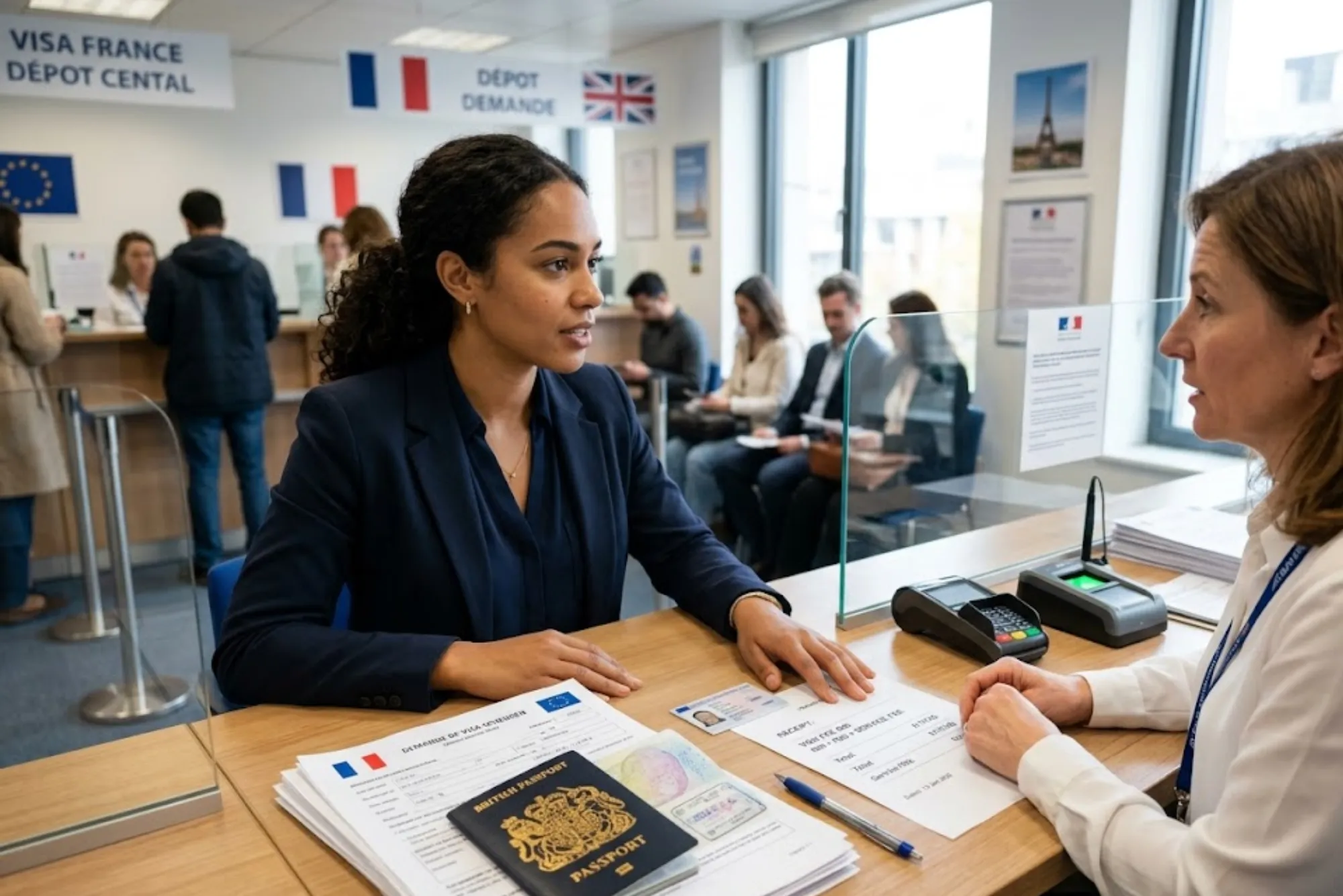
In most countries, France has contracted VFS Global to collect visa applications, take biometric data, and act as the document processing intermediary. VFS charges a separate service fee on top of the French consular visa fee, and this amount varies by country. By EU law, the external service fee cannot exceed 50% of the applicable visa fee — meaning for standard adult applicants, the maximum lawful VFS charge is €45.
In practice, most countries see VFS France charges in the range of €28–€40. Countries with higher application volumes or additional service infrastructure sometimes charge at the upper end of this range. VFS also offers optional add-on services — document checklist verification, form-filling assistance, SMS updates, and premium lounge appointments — each priced separately. None of these extras influence the consular decision itself; they affect only the submission experience.
For applicants researching the full visa fee picture across multiple destinations they may visit during a Europe trip, our guide to the Thailand tourist visa price in 2026 and our Hong Kong visa price guide offer useful Asia-side comparisons for those planning broader multi-continent itineraries.
France Visa Cost by Nationality: Estimates from Major Applicant Countries
| Country of Application | Govt. Fee (€) | VFS Charge (approx.) | Insurance (approx.) | Estimated Total |
|---|---|---|---|---|
| India | €90 | ~€30–€35 | ~€30–€50 | ~€150–€175 (~₹13,500–15,750) |
| Pakistan | €90 | ~€28–€35 | ~€25–€45 | ~€143–€170 |
| Nigeria | €90 | ~€30–€40 | ~€30–€55 | ~€150–€185 |
| UAE / GCC | €90 | ~€28–€35 | ~€25–€45 | ~€143–€170 |
| Egypt | €90 | ~€28–€36 | ~€25–€50 | ~€143–€176 |
| Serbia (reduced bilateral fee) | €35 | ~€28–€35 | ~€25–€45 | ~€88–€115 |
| All amounts in EUR approximate. VFS charges vary by country — verify with your local VFS France portal. Insurance costs vary by provider and trip duration. | ||||
Documents Required for a France Schengen Visa Application
The French consular system evaluates applications on the basis of genuine temporary intent and the ability to financially sustain the trip. A strong application is built on consistency — every document should reinforce the same narrative: a genuine tourist with clear means and strong ties to their home country.
- Valid passport — issued within the last 10 years; at least 3 months validity beyond the intended departure date from the Schengen Area; minimum 2 blank pages
- Completed Schengen visa application form — filled online through the France-Visas portal (france-visas.gouv.fr), printed, and personally signed
- Two recent biometric photographs — 35×45mm, white background, full face, taken within the last 3 months; printed photographs (not photocopies or phone prints)
- Schengen travel insurance certificate — minimum €30,000 coverage for medical and repatriation; valid across all Schengen states; covering the full duration of the trip
- Confirmed travel itinerary — round-trip flight bookings or reservations; most applicants can use reservation confirmations rather than fully paid tickets
- Proof of accommodation — hotel bookings for all nights in France; or an invitation letter from a French host with their address and identity document copy
- Financial proof — bank statements for the last 3–6 months; a general benchmark of €65–€100 per day per person is widely referenced, though no fixed statutory minimum exists
- Proof of home ties — employment letter, payslips, leave approval, property ownership, tax returns, or family commitments; essential for demonstrating you will return home
- Cover letter (for complex applications) — explaining the purpose and itinerary of the trip in clear, concise terms
Step-by-Step: How to Apply for a France Visa in 2026
France visa applications go through VFS Global in most countries. The process is well-structured, but several steps have specific sequencing requirements that applicants often get wrong on their first attempt.
-
Apply at the right mission
You must apply to the French Embassy, Consulate, or its designated VFS centre that has jurisdiction over your area of legal residence. You cannot apply at any French mission you choose — jurisdiction is determined by your registered address. The France-Visas website (france-visas.gouv.fr) has a mission finder that identifies the correct submission point for your location. -
Complete the online application form
Use the France-Visas portal to complete your application form digitally. The system generates a printable form with a unique barcode. Do not handwrite amendments on the printed form — any corrections require restarting the digital form. The barcode links your form to your biometric data collected at VFS. -
Book your VFS appointment
Log into the VFS France portal for your country and schedule a biometric appointment. In high-demand countries (India, Pakistan, Nigeria), VFS appointment slots fill several weeks in advance — book as early as possible. You can apply up to 6 months before your intended trip and no earlier. -
Prepare your complete document set
Gather originals and one full set of photocopies of every document listed in the requirements section. Organise them in the recommended order for your VFS centre — the guidance is available on the VFS France website for your country. Documents not in French or English must be accompanied by a certified translation. -
Attend your biometric appointment and pay fees
Arrive at the VFS centre with your passport, printed application form, all documents, photographs, and payment. The government visa fee (€90) and the VFS service fee are typically paid at or before the appointment — confirm your VFS centre’s accepted payment methods beforehand, as these vary by country (cash, card, or bank draft). -
Track your application and collect your passport
After your biometric appointment, your documents are forwarded to the French consular section for a decision. Standard processing takes up to 15 calendar days from the date TLSCONTACT or VFS receives a complete application. Track status via the VFS portal. Collect your passport at the same VFS centre or by courier if you selected that option.
The France / Schengen visa fee is non-refundable once submitted and biometrics have been given — regardless of whether the visa is approved, refused, or withdrawn. There are no exceptions. Pay only when your document set is complete and you are confident in the accuracy of all information submitted.
France Visa Processing Time in 2026
Standard processing for a France Schengen visa takes up to 15 calendar days from the date the French consular section receives your complete application. In practice, many applications from straightforward profiles are decided faster — within 5–10 working days. However, during peak travel periods (April–June and September–November), and from high-volume applicant countries, processing can extend to 30 days or more.
The French consulate recommends applying at least 15 days before your intended travel date, but in practice, applying 6–8 weeks before travel is far more sensible. This provides a comfortable buffer for any requests for additional documents and removes the financial pressure of having booked non-refundable flights before knowing the visa outcome.
The standard consular advice says you need a confirmed flight itinerary to apply. The practical workaround: most French consulates accept a reservation confirmation (not a paid ticket) for the application stage. Once you have visa approval, convert the reservation into a paid booking. This protects you from the risk of losing a non-refundable ticket if a visa is refused.
France Visa vs. Other Popular Schengen and European Destinations: Is the Fee the Same?
Because France is a Schengen member, its Type C short-stay visa fee is the same as Germany, Italy, Spain, Netherlands, and every other Schengen state at €90 for adults. The Schengen Visa Code standardises this fee across all member states, so the government fee does not change regardless of which Schengen country you apply through.
What can differ is which country’s consulate processes your application. Most experienced travellers know that when their primary destination is France but they plan to visit other Schengen countries, they apply through the French mission (as the country of longest stay or first point of entry if stays are equal). A France Schengen visa allows free movement across all 27 Schengen states — it is not restricted to France.
| Destination | Visa Type | Government Fee | Realistic Total |
|---|---|---|---|
| France (Schengen) | Type C Short-Stay | €90 | ~€150–€250 all-in |
| United Kingdom | Standard Visitor Visa | £135 (~€162) | ~£150–£180+ |
| United States | B-1/B-2 Tourist | $185 (~€170) | ~$205–$220 |
| Canada | TRV + Biometrics | CAD $185 (~€125) | ~CAD $210–$240 |
| China | L-Visa (tourist) | ~CNY 280–390 | ~€45–€85 equiv. |
| Thailand | Tourist eVisa / VoA | THB 1,500–2,000 | ~€40–€60 equiv. |
| India | eVisa (tourist) | $25–$80 USD | ~$30–$90 |
France’s €90 fee is higher than most Asian destination visas, comparable to US visa costs, and slightly lower than the UK Standard Visitor Visa at £135. For multi-country European itineraries, however, a single €90 France visa covering all 27 Schengen countries represents exceptional geographic coverage for the price.
Common Mistakes That Lead to France Visa Rejections
- Applying through the wrong French mission — jurisdiction is based on your area of legal residence, not your nationality. Applying to the wrong consulate results in your application being returned unprocessed, wasting weeks of lead time.
- Insurance that does not meet Schengen specifications — travel insurance that covers only France (not all Schengen states), or that provides less than €30,000 in medical/repatriation coverage, is rejected outright. Read the policy wording carefully before purchasing.
- Insufficient evidence of home ties — the most consistent cause of refusal for South Asian and African applicants. Without an employment letter, property documentation, family responsibilities, or other compelling evidence of reasons to return home, the application lacks the assurance of departure that consular officers require.
- Bank statements that show sudden large deposits before application — regular income and consistent transaction history are what consular officers look for; unexplained large deposits create suspicion about the genuine source of funds and can trigger refusal.
- Not applying early enough — the 15-day statutory minimum for processing is not a recommended timeline — it is the bare legal minimum. Applying 6 weeks before travel for the first time, or 4 weeks for straightforward repeat applicants, is far more sensible.
- Using outdated visa fee tables — the June 2024 increase from €80 to €90 is now 2 years old, yet some websites still show the €80 figure. Always verify the current fee on the France-Visas portal (france-visas.gouv.fr) on the day you plan to pay.
Pakistani applicants planning France travel alongside other international destinations may also find our Pakistan to USA visit visa price guide helpful for comparing the French Schengen process against one of the most demanding visa applications in the world.
Frequently Asked Questions: France Visa Price in 2026
1. Is the France visa fee the same as other Schengen countries?
Yes — the Schengen Visa Code mandates a uniform government visa fee across all 27 Schengen member states. The adult fee of €90 applies whether you apply through the French Consulate, the German Embassy, the Dutch Consulate, or any other Schengen mission. What varies slightly between countries is the VFS or TLSCONTACT service charge on top of this fee, which is set locally by the external service provider.
2. Can I visit other European countries on a France Schengen visa?
Yes — a Schengen Type C visa issued by France grants legal entry and free movement across all 27 Schengen Area member states for the visa’s validity period, up to a maximum of 90 days within any 180-day rolling window. You are not restricted to France — you can travel to Germany, Italy, Spain, Netherlands, and all other Schengen states on the same visa, with no additional fee.
3. Is the France visa fee refundable if my application is refused?
No — the Schengen visa fee is entirely non-refundable once the application has been submitted and biometric data has been given. This applies regardless of the outcome (approved, refused, or withdrawn). If you need to reapply after a refusal, the full fee must be paid again. This makes thorough document preparation before payment especially important.
4. How long does a France Schengen visa take to process?
Standard processing takes up to 15 calendar days from the date the French consular section receives your complete application. During peak travel periods or from high-volume applicant countries, this can extend to 30 days or more. Apply at least 6 weeks before your travel date to allow a comfortable buffer, particularly if it is your first France visa application.
5. What is the minimum travel insurance required for a France visa?
Schengen regulations require travel insurance with a minimum coverage of €30,000 for medical emergencies and repatriation. The policy must be valid in all Schengen states (not just France) and must cover the complete duration of your intended trip. Policies with lower coverage or limited geographical validity will be rejected by the French consular section. Most reputable travel insurance providers offer Schengen-compliant policies for €25–€60 depending on trip length.
France Visa Price in 2026: Complete Summary
The visa price for France in 2026 starts with the government Schengen Type C fee of €90 for adults — a rate unchanged since the June 2024 Schengen Visa Code revision. Children aged 6–11 pay €45, and under-6s are exempt from the fee. Selected nationalities (primarily Balkan states) pay a reduced €35. The French national long-stay visa (Type D) costs €99 for adults across most categories.
The realistic total for a standard adult application including VFS service charge and mandatory Schengen insurance sits in the range of €150–€250, depending on your country of application and insurance provider. All fees are non-refundable once submitted — which makes preparing a complete, consistent, and well-evidenced application before paying the single most important thing you can do to protect your investment.
France’s Schengen visa is also valid for the entire Schengen Area — 27 countries on a single €90 document represents remarkable geographic value for European itinerary planning. Apply through the France-Visas portal, give yourself 6–8 weeks lead time before travel, and read the insurance requirements carefully. For more detailed visa cost comparisons across popular destinations, explore our full range of travel price and visa guides at TourTutors.