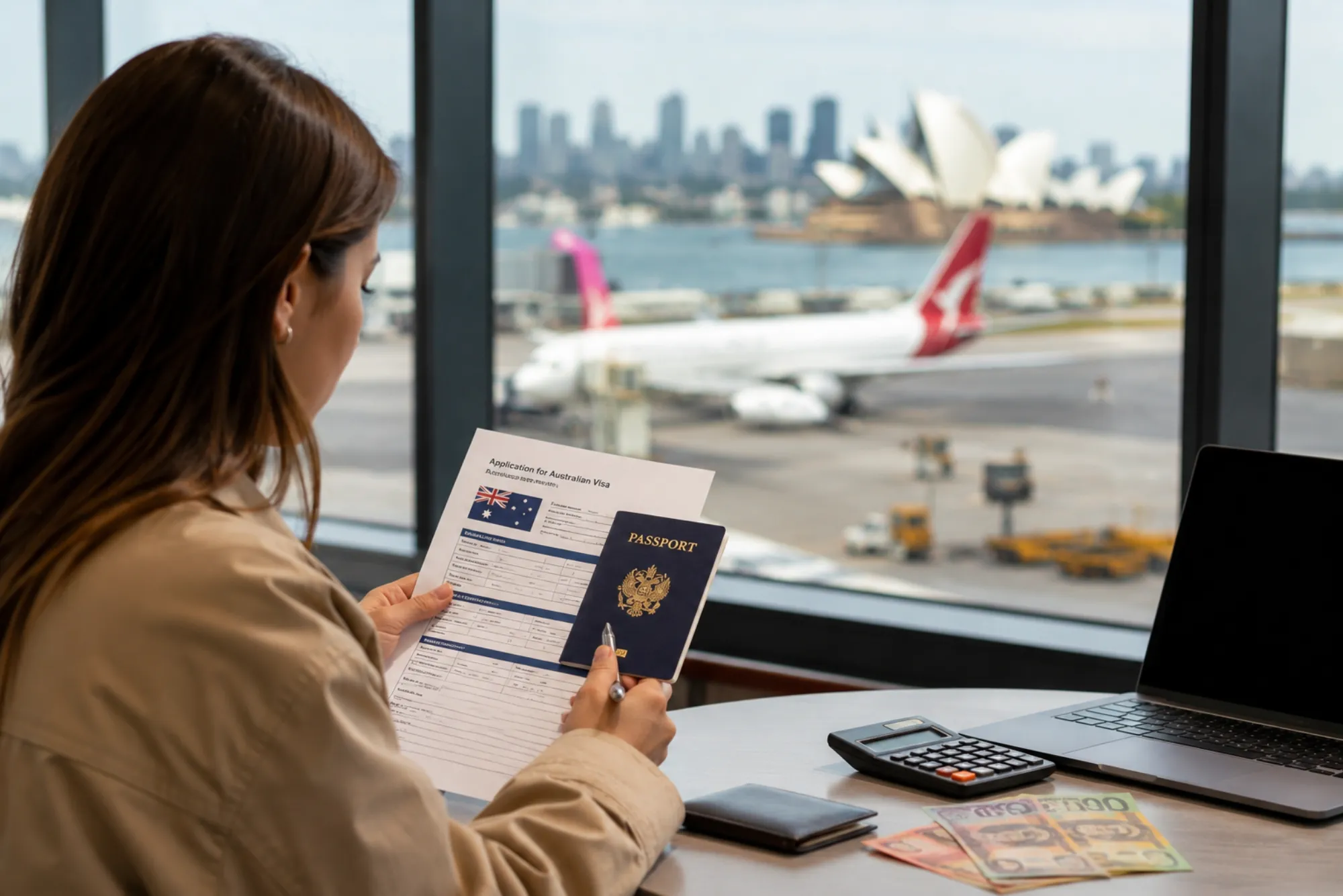

Australia’s Department of Home Affairs sets Visa Application Charges (VACs) that are reviewed and adjusted annually in line with the Consumer Price Index. The 2025–2026 financial year brought increases across most categories, continuing a trend of steady upward movement that has made Australia one of the more costly visa destinations for students and skilled migrants in particular. The framework also includes mandatory auxiliary costs — health examinations, character checks, translations, and health insurance — that compound the government fee significantly for many applicant profiles. For context on how Australia compares to other major visa destinations, the visa prices and costs guides on TourTutors cover multiple destination breakdowns in one place.
How Australia’s Visa Application Charge System Works
The Visa Application Charge (VAC) is the government fee paid to the Department of Home Affairs when a visa application is lodged. It is paid online through the ImmiAccount portal and is non-refundable once the application has been processed — even if the visa is refused. The VAC differs by visa subclass, not by the applicant’s nationality; an Indian national and a British national applying for the same subclass pay the same government fee.
However, the total cost of the visa process varies significantly by nationality because some nationalities face additional mandatory requirements — health examinations, police clearance certificates from multiple countries, and in some cases enhanced document verification. These auxiliary costs are separate from the VAC and paid to third-party service providers, not to the Australian government directly. The distinction matters because applicants who budget only the VAC substantially underestimate what the complete visa process will actually cost.
Australia Tourist Visa Prices (Subclass 600) in 2026
The Visitor visa subclass 600 is the standard Australian tourist visa for international visitors. The government VAC for this subclass sits at AUD 190 in the 2025–2026 financial year — a fee that has remained relatively stable in recent years. However, this headline figure applies to the basic application. Auxiliary costs can bring the realistic total to AUD 400–700 depending on the applicant’s nationality and documentation situation.
| Cost Component | Amount (AUD) | Mandatory? |
|---|---|---|
| Visa Application Charge (Subclass 600) | AUD 190 | Yes |
| Police clearance certificate | AUD 42 – 150 (varies by country) | Sometimes |
| Health examination (if required) | AUD 300 – 500 | Conditional |
| Document translation (certified) | AUD 50 – 200 per document | If non-English docs |
| Migration agent service fee (optional) | AUD 200 – 600 | No |
| Total Realistic Range | AUD 190 – 1,440 | — |
Applicants from countries with short travel history to Australia, from higher-risk processing categories, or who have spent time in countries requiring health screening will generally sit at the higher end of this range. Most straightforward tourist applications from low-risk nationalities — UK, USA, Germany, Japan — involve only the AUD 190 VAC plus minimal document costs and are processed within 25–45 days.

Free and Low-Cost Entry Options for Australia
Not every visitor to Australia pays AUD 190 or more for visa access. Two specific categories offer significantly lower-cost entry:
eVisitor Visa (Subclass 651)
Citizens of 36 European countries — including all EU member states plus several others — can apply for the eVisitor visa entirely free of charge. The subclass 651 allows stays of up to three months per visit within a 12-month period, is linked electronically to the passport, and requires no fee payment at any stage of the application. For eligible European nationals, Australia is genuinely a zero-cost entry destination from a visa perspective.
Electronic Travel Authority (Subclass 601)
Citizens of eligible countries — including the United States, Canada, Japan, South Korea, Singapore, and Hong Kong — can apply for an ETA through the official Australian ETA app or a registered travel agent. The government system charge is AUD 20, making this the most affordable paid entry option for eligible nationalities. Some travel agents and third-party apps add a service fee of AUD 10–30 on top. Total cost: AUD 20–50 for an ETA granting multiple-entry access with stays of up to 3 months per visit within 12 months.
Australia Student Visa Prices (Subclass 500) in 2026
The student visa is where Australia’s visa pricing becomes considerably more significant. The base government VAC for subclass 500 is AUD 1,600 in 2026. For most international student markets — India, China, Philippines, Nepal, Pakistan, Colombia — this is just the starting point of a fee chain that includes mandatory Overseas Student Health Cover (OSHC), English language testing, and frequently health examinations.
| Cost Component | Amount (AUD) |
|---|---|
| Visa Application Charge (Subclass 500) | AUD 1,600 |
| OSHC (Overseas Student Health Cover) — 12 months | AUD 500 – 700 (single student) |
| Health examination (if required) | AUD 300 – 500 |
| English test (IELTS/PTE Academic) | AUD 350 – 500 |
| Document translation (where applicable) | AUD 100 – 400 |
| Migration agent fee (optional) | AUD 500 – 1,500 |
| Total Estimated Range | AUD 2,850 – 5,200 |
OSHC is not optional — it is a visa condition for all international students on subclass 500. The mandatory health cover must be maintained for the duration of the visa and is renewed annually. Students with dependants must also purchase OSHC for each accompanying family member, which adds AUD 400–600 per dependant per year to the health cover cost. A student bringing a spouse and one child to Australia on a three-year degree would pay approximately AUD 3,600–6,300 in OSHC across the entire visa period — a significant recurring cost that deserves explicit budget planning from the outset.
Working Holiday Visa (Subclass 417 and 462) Prices in 2026
The Working Holiday visa remains one of Australia’s most popular visa products, attracting young travellers from over 40 eligible countries who want to work and travel simultaneously. The VAC for both subclass 417 and subclass 462 is AUD 650 in 2026. This fee remains the same for first, second, and third year applications — each year’s extension requires a new application and a new AUD 650 charge.
| Working Holiday Visa Stage | Subclass | VAC (AUD) | Regional Work Requirement |
|---|---|---|---|
| First Year | 417 or 462 | AUD 650 | Not required |
| Second Year Extension | 417 or 462 | AUD 650 | 3 months specified regional work |
| Third Year Extension | 417 or 462 | AUD 650 | 6 months specified regional work |
| Full 3-Year WHV Cost | — | AUD 1,950 | — |
The working holiday visa does not require mandatory health cover in the same way as the student visa — holidaymakers are responsible for their own travel insurance arrangements. However, Australia’s private healthcare costs without insurance are high, and purchasing comprehensive travel insurance for a 12-month stay is strongly advisable and adds AUD 400–800 to the practical cost of a working holiday year. For travellers interested in what Australia has to offer during a working holiday or extended visit, some surprisingly insightful context about Australian culture and expression can be found in the Australian language and culture guide on TourTutors.
Skilled Migration Visa Prices: Australia’s Investment in Permanent Residency
Australia’s skilled migration pathway — covering subclasses 189 (Skilled Independent), 190 (Skilled Nominated), and 491 (Skilled Work Regional, Provisional) — carries some of the highest government visa fees in the Australian system. These are employer-independent pathways where applicants are selected through an Expression of Interest (EOI) points-based system and then invited to apply.
| Visa Subclass | Primary Applicant VAC (AUD) | Secondary Adult VAC (AUD) | Child VAC (AUD) |
|---|---|---|---|
| Subclass 189 — Skilled Independent | AUD 4,640 | AUD 2,320 | AUD 1,160 |
| Subclass 190 — Skilled Nominated | AUD 4,640 | AUD 2,320 | AUD 1,160 |
| Subclass 491 — Skilled Work Regional | AUD 4,640 | AUD 2,320 | AUD 1,160 |
| Subclass 186 — Employer Nomination Scheme | AUD 4,770 | AUD 2,385 | AUD 1,195 |
| Subclass 482 — Temporary Skill Shortage | AUD 3,115 | AUD 780 | AUD 780 |
A skilled migrant applying with their spouse and two children for subclass 189 pays AUD 9,160 in government VAC alone. Add skills assessment fees (AUD 500–1,500 depending on the assessing authority), English language testing (AUD 350–500), health examinations for all family members (AUD 300–500 each), police clearance certificates, and migration agent costs (typically AUD 3,000–8,000 for skilled migration), and the total investment for a family skilled migration application frequently exceeds AUD 20,000. This is the financial reality that the Department of Home Affairs’ headline VAC figure does not convey — and it is the cost structure that requires the most comprehensive upfront budgeting of any Australian visa category.
Partner and Family Visa Prices in Australia 2026
The partner visa — available to spouses and de facto partners of Australian citizens or permanent residents — is one of the most expensive visa products in the Australian immigration system by government VAC. The primary applicant’s charge for the onshore partner visa (subclass 820/801) or offshore partner visa (subclass 309/100) is AUD 8,850 in 2026, and this fee must be paid at the time of lodgement — not upon approval.
Partner visas in Australia operate as a two-stage grant: the initial visa (subclass 820 onshore or 309 offshore) is a temporary visa granted for approximately two years, at which point applicants are assessed for the permanent partner visa (subclass 801 or 100). The single AUD 8,850 VAC covers both stages — no additional VAC is charged when the permanent stage is assessed. However, the two-year wait for permanency means health examinations, which are valid for a fixed period, may need to be repeated if they expire before the permanent stage is finalised — an additional cost of AUD 300–500 per family member for repeat examinations.
Australian Visa Health Examination: Who Needs It and What It Costs
The health examination requirement is one of the most frequently overlooked cost components in Australian visa applications. The Department of Home Affairs requires health examinations for many visa applicants depending on the visa subclass, the length of stay, and the applicant’s travel and residence history. Examinations are conducted by BUPA-approved panel physicians in the applicant’s country of residence.
- Standard health examination (chest X-ray + general physical): AUD 300–450 per person (cost equivalent charged locally by panel physician)
- HIV test (if required for certain visa types and age groups): AUD 60–120 additional
- Repeat examination (if previous exam expires before visa grant): Full cost applies again
- Health examinations for dependants: Same per-person cost applies to each family member
The health requirement is triggered by the visa subclass applied for and the applicant’s cumulative time spent in countries on Australia’s Tuberculosis-risk list. Applicants who have spent more than three months in high-prevalence countries within the past five years are routinely required to undergo health screening even for tourist visa applications. This can add AUD 300–500 per person to a tourist visa application cost without warning if the applicant is not aware of their travel history’s effect on the health requirement trigger.
Australia Visa Application Process: Step-by-Step
- Step 1 — Identify the correct visa subclass: Australia’s visa framework has over 100 subclasses. Using the wrong one means paying again. Use the Department of Home Affairs’ visa finder tool or consult a registered migration agent for complex situations.
- Step 2 — Create an ImmiAccount: All Australian visa applications are lodged online through ImmiAccount (immi.homeaffairs.gov.au). Create an account before beginning to avoid duplicate applications or profile errors.
- Step 3 — Gather and translate documents: Collect all required supporting documents. Non-English documents must be translated by a NAATI-accredited translator for Australian immigration purposes — not simply a bilingual translator or generic translation service.
- Step 4 — Complete health examination (if required): Book and attend the panel physician examination. Do not book flights or accommodation before confirming your health examination results, as adverse findings can significantly extend processing times.
- Step 5 — Lodge the application and pay the VAC: Complete the application form in ImmiAccount and pay the government VAC by credit card (Visa, Mastercard, Amex) or debit card. Bank conversion fees apply for non-AUD cards — typically 1.5–3% of the transaction amount.
- Step 6 — Respond to requests (if any): The Department may issue a request for additional information or documents at any point during processing. Respond within the specified timeframe — failure to respond can result in application refusal without further notice.
- Step 7 — Receive the visa decision: Approved visas are granted electronically and linked to the passport number — there is no physical sticker for most Australian visa subclasses. Keep the grant notification email as evidence of the visa grant.
Processing Times by Visa Category in 2026
Processing times for Australian visas vary significantly by subclass and can affect the overall cost calculation if delays extend beyond health examination validity periods or require additional document updates.
| Visa Subclass | 75% of Applications Completed | 90% of Applications Completed |
|---|---|---|
| Subclass 600 (Visitor) | 29 days | 55 days |
| Subclass 651 (eVisitor) | 1 day | 2 days |
| Subclass 601 (ETA) | Instant | 1 day |
| Subclass 500 (Student) | 24 days | 51 days |
| Subclass 417/462 (Working Holiday) | 14 days | 28 days |
| Subclass 189 (Skilled Independent) | 7 months | 13 months |
| Subclass 820/801 (Partner) | 17 months | 28 months |
| Subclass 482 (TSS Work) | 2 months | 4 months |
The partner visa’s processing times — 17 to 28 months for the majority of applications — are the most significant in the system and have direct financial implications: health examinations (valid for 12 months) may expire and require repetition, and applicants may need to update police clearance certificates (often valid for only 12 months in the applying country) during the processing period.
Australia Visa Fees Compared to Other Major Study Destinations
For students choosing between Australia and other English-speaking study destinations, the visa cost comparison is a meaningful input to the overall education financial planning decision. Australia’s student visa (subclass 500) at AUD 1,600 is considerably more expensive than the US F1 ($185 MRV + $350 SEVIS = ~AUD 830 total), the UK student visa (£490 + IHS), and Canada’s student permit (~CAD 185). However, Australia’s post-study work rights — the Graduate Temporary Activity Visa (subclass 485) — offer 2–4 years of post-graduation work access, which represents significant long-term value when factored against the visa cost.
For students specifically comparing Thailand as a more affordable short-term study option against Australia’s longer-term programs, cost details for Thailand’s student and visit visa categories are available at the Thailand visit visa price guide on TourTutors.
Mistakes That Cost Australian Visa Applicants More Money
- Applying for the wrong subclass: The most expensive error in the entire process. A tourist visa (subclass 600) lodged when a student visa (subclass 500) was needed — or vice versa — results in a refusal and the loss of the full VAC. Using ImmiAccount’s subclass selector or consulting a registered migration agent before applying avoids this entirely preventable loss.
- Letting health examination results expire: Health examinations conducted through the Department of Home Affairs’ medical panel are valid for a limited period (typically 12 months from the date of the examination). For long-processing visa subclasses like partner and skilled migration visas, examinations can expire before the visa is granted, requiring a repeat examination at full cost.
- Using non-NAATI-accredited translators: The Department of Home Affairs accepts translations only from NAATI-accredited translators or translators who can demonstrate equivalent qualifications. Documents translated by non-accredited providers are rejected and must be retranslated — an additional cost on top of the original translation.
- Not budgeting for auxiliary costs: The most common financial planning failure in Australian visa applications is budgeting only the VAC and being caught off guard by OSHC, health examinations, skills assessments, and English testing costs that collectively can exceed the VAC itself for complex applications.
- Submitting incomplete applications to avoid gathering more documents: The Department of Home Affairs can refuse applications that are materially incomplete without giving applicants an opportunity to correct them. Gathering all required documents before lodging — even if it delays the application by weeks — is always preferable to an incomplete lodgement that results in refusal and a repeated VAC payment.
Visa Refund Policy: Can You Get Your Money Back?
Australia’s refund policy for visa application charges is limited and conditional. The Department of Home Affairs provides a full refund if a visa application is withdrawn before any work is done on it — in practice, this means withdrawing within hours or days of lodgement. A partial refund (typically 50% of the VAC) may be available if the application is withdrawn after work has commenced but before a decision is made, depending on the visa subclass. Once a decision has been made — approval or refusal — no refund of any portion of the VAC is available.
This non-refundable structure is why application quality and completeness are so financially important. An application refused for a preventable documentation issue — an expired police certificate, a missing financial evidence document, an unanswered departmental request — results in the complete loss of the VAC and the full cost of auxiliary documents, none of which are recoverable.
Frequently Asked Questions About Visa Prices Australia in 2026
How much does an Australian tourist visa cost in 2026?
The Visitor visa (subclass 600) government fee (VAC) is AUD 190. Total costs including any required health examinations, document translation, and optional migration agent assistance typically range from AUD 190 (straightforward applications from low-risk nationalities) to AUD 1,440 for more complex cases. The eVisitor visa (subclass 651) for eligible Europeans is free; the ETA (subclass 601) for eligible nationalities costs AUD 20 in government charges.
How much is the Australian student visa (subclass 500) in 2026?
The government VAC for subclass 500 is AUD 1,600. When mandatory OSHC (AUD 500–700/year), English testing (AUD 350–500), and health examination (AUD 300–500 if required) are included, the total realistic cost of the student visa application ranges from approximately AUD 2,850 to AUD 5,200 depending on the applicant’s specific circumstances and whether a migration agent is used.
Is the Australian visa fee refundable if refused?
No. Once a visa decision (approval or refusal) has been made, the VAC is not refundable. A partial refund may apply if the application is withdrawn after lodgement but before assessment work begins. Given the non-refundable nature of the charge, ensuring all documents are complete and the correct subclass has been selected before lodging is essential to avoid losing the application fee to a preventable refusal.
Do children pay the same visa fee as adults for Australian visas?
No. Secondary applicants who are children typically pay approximately 50% of the primary applicant’s VAC for most visa subclasses. The exact child VAC is specified by subclass on the Department of Home Affairs website and should be verified for the specific subclass being applied for, as rates vary.
What is OSHC and is it mandatory for an Australian student visa?
Overseas Student Health Cover is mandatory private health insurance for all international students holding a subclass 500 student visa. It must be purchased for the full duration of the visa and maintained throughout the stay. The annual cost for a single student is approximately AUD 500–700 from OSHC providers such as BUPA, Medibank, AHM, or Allianz. Family cover for accompanying spouses and children adds significantly to this annual cost.
Conclusion: Know the True Visa Prices Australia in 2026 Before You Apply
The visa prices Australia charges in 2026 span an extraordinary range — from AUD 0 for eligible European eVisitor applicants to over AUD 20,000 in total for a family skilled migration pathway. The government VAC is the starting point, not the destination. For tourist applicants, the real cost is AUD 190–700. For students, AUD 2,850–5,200. For skilled migrants with families, the full investment regularly exceeds AUD 15,000–20,000 when all auxiliary costs are properly accounted for. Understanding this framework before beginning an application is the most important step any prospective Australian visa applicant can take — and it makes the difference between a financially prepared application and one that encounters costly surprises at every stage. For comprehensive visa cost comparisons across multiple destinations to help you plan and compare your options, the full pricing and visa guides on TourTutors provide an ongoing reference for 2026 immigration planning.