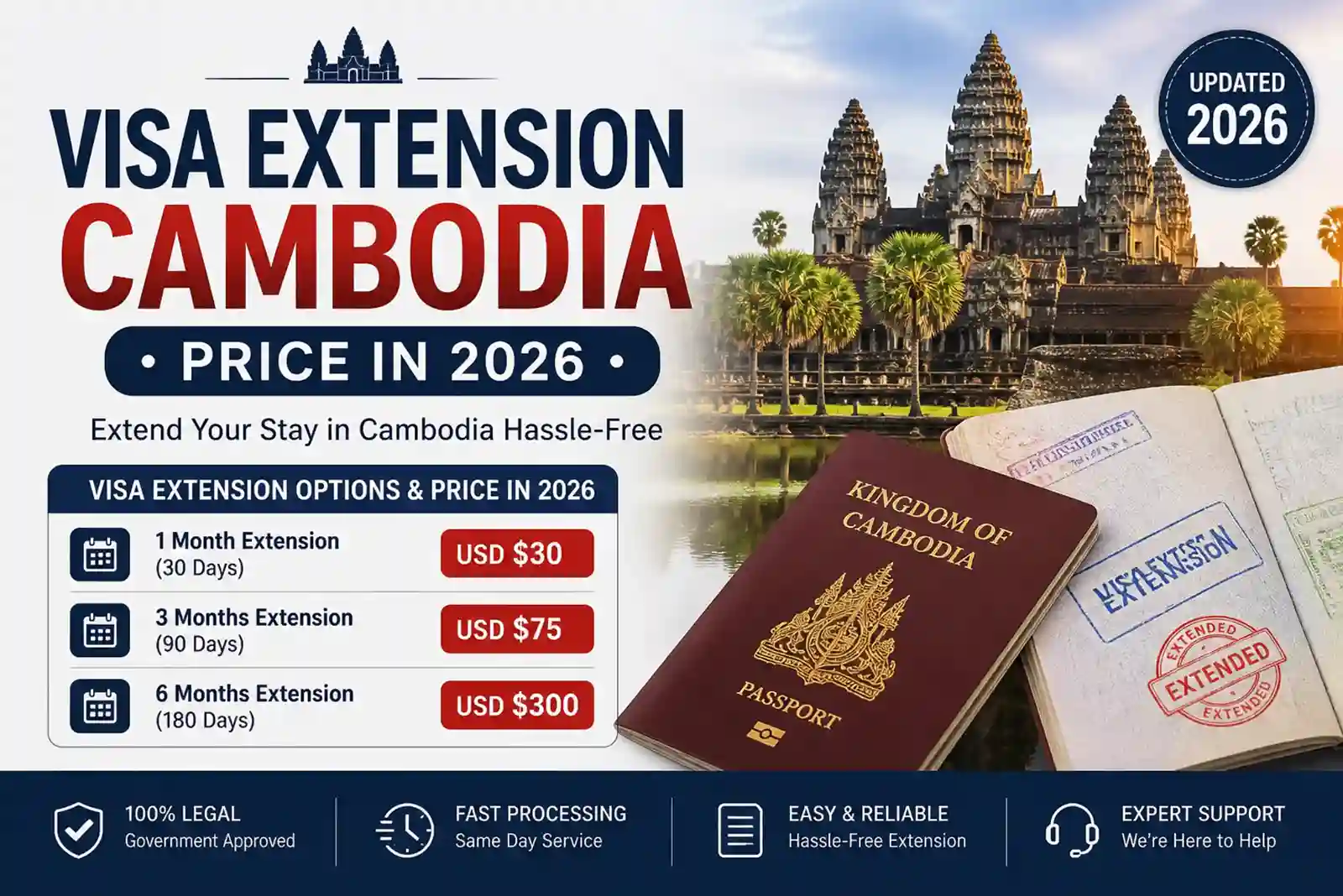

Cambodia remains one of Southeast Asia’s most accessible long-stay destinations — but knowing exactly how much a visa extension costs in 2026, which office to visit, and what penalties apply if you overstay can make a significant difference to your budget and your border experience. This guide covers everything with clear numbers and no guesswork.
How Cambodia’s Visa Extension System Works
Cambodia issues two main types of visas on arrival and through its e-visa portal: the Tourist Visa (Type T) and the Ordinary Visa (Type E). Each has a different extension pathway, different maximum stay allowances, and importantly, different prices. Understanding which visa you hold before you attempt to extend it is the essential first step — attempting to extend a tourist visa through a business extension channel, for example, will be rejected.
Extensions are processed through the Department of Immigration in Phnom Penh, or through authorized visa agents found in most major tourist hubs including Siem Reap, Sihanoukville, and Kampot. The Cambodian government does not currently offer an online extension portal — all extensions require either a physical visit or processing through a licensed agent.
If you are planning your Southeast Asia trip and Cambodia is one of several stops, it helps to think ahead about travel logistics. For those combining Cambodia with a visit to Malaysia, a practical guide on traveling between Malaysian destinations can help you plan the wider regional itinerary around your visa dates.
Cambodia Visa Extension Price Table 2026
| Extension Type | Visa Type Required | Duration Added | Official Fee (USD) | Agent Fee (Approx.) | Processing Time |
|---|---|---|---|---|---|
| Tourist Visa — Single Extension Most Common | Type T (Tourist) | 30 days | $45 | $50–$65 | Same day – 3 days |
| Ordinary Visa — 1 Month Extension | Type E (Ordinary) | 30 days | $45 | $50–$65 | 1–3 days |
| Ordinary Visa — 3 Month Extension | Type E (Ordinary) | 90 days (single entry) | $75 | $80–$100 | 2–5 days |
| Ordinary Visa — 6 Month Extension | Type E (Ordinary) | 6 months | $155 | $165–$185 | 3–5 days |
| Ordinary Visa — 12 Month Extension Long Stay | Type E (Ordinary) | 1 year (multiple entry) | $290 | $300–$350 | 5–7 days |
| Business/Work Permit Extension | Type E + employer sponsorship | 1 year | $290+ | $350–$600 | 1–2 weeks |
| Overstay Penalty (per day) Avoid | Any visa type | N/A | $10/day | Paid at border | Immediate |
Cambodia enforces its overstay penalty without exception. At $10 per day from the moment your visa expires, a two-week overstay adds $140 to your exit costs. Travelers with extended overstays may also face a ban on future entry. Always extend before your visa expires — not after. There is no grace period.
Quick Cost Comparison at a Glance
Tourist Visa Extension
One-time 30-day extension. Cannot be extended again — you must exit Cambodia afterward.
3-Month Ordinary Visa
Single-entry extension ideal for medium-term stays. Requires Type E visa at entry.
12-Month Business Extension
Multi-entry. Best value for long-term residents and expats. Renewable annually.
Tourist Visa vs Ordinary Visa: Which One Can Be Extended?
This is the most important distinction for travelers in Cambodia. The Tourist Visa (Type T) can only be extended once, for a maximum of 30 additional days, at a cost of $45. Once that extension is used, the only legal option is to exit Cambodia and re-enter. There is no second tourist visa extension.
The Ordinary Visa (Type E) is the flexible long-stay option. It can be extended repeatedly in increments of one month, three months, six months, or one year. Anyone planning to spend more than 60 days in Cambodia — whether for travel, work, volunteering, or retirement — should enter on a Type E visa rather than a tourist visa. The e-visa portal and most Cambodian embassies issue both types; simply select Type E (sometimes listed as “Ordinary Visa”) when applying.
How to Extend Your Visa in Cambodia: Step by Step
Agent Fees: Are They Worth It?
Using a visa agent in Cambodia is entirely legal and widely practiced. The markup over official fees is modest — typically $10 to $30 for standard extensions — and the service saves you the trip to Phnom Penh’s immigration office, which is not centrally located. For travelers based in Siem Reap or Sihanoukville, an agent is almost always the more practical choice.
The risk with agents is using an unlicensed operator. There have been documented cases of travelers paying agent fees only to receive extensions that were not properly processed, resulting in technical overstays they were unaware of. Stick to agents recommended by your guesthouse, hotel, or with clearly displayed licensing credentials. Never hand over your passport without a written receipt.
Long-Term Stay Options and Annual Costs
The 12-Month Ordinary Visa Extension
For expats, digital nomads, and retirees planning to base themselves in Cambodia, the 12-month Type E extension at $290 remains one of Southeast Asia’s most affordable long-term visa solutions. It grants multiple-entry privileges, meaning you can travel in and out of Cambodia freely throughout the year without the cost of additional extensions or fresh visas.
Annualized, $290 works out to under $25 per month for your legal right to live in Cambodia — a figure that compares extremely favorably against long-term visa costs in Thailand, Vietnam, or Indonesia. When combined with Cambodia’s low cost of living, it is a strong draw for budget-conscious long-term travelers.
If you’re researching affordable accommodation to match Cambodia’s low visa costs, reading through hotel price guides for budget-friendly stays can help you map out realistic monthly living costs alongside your visa expenses.
Retirement and Business Considerations
Cambodia does not have a dedicated retirement visa category — retirees typically use the annual Type E extension, often under a “social” or general category. Business owners and employed expats require an extension linked to their business registration or work permit, which involves additional employer documentation and typically costs $290 to $600 depending on the nature of the work authorization.
What Changes in 2026 to Watch For
Cambodia’s immigration department periodically revises fee schedules without extensive advance notice. The fees in this guide reflect the current official structure as of early 2026, but travelers planning long stays should verify directly with the Department of Immigration or a licensed agent at the time of their extension. Fee increases of $5–$15 on specific categories have occurred in previous years with minimal public announcement.
There have also been ongoing discussions about introducing a more formalized digital nomad or remote work visa category, which several neighboring countries have already launched. If such a visa is introduced in Cambodia during 2026, it may offer a more structured pathway for location-independent workers currently relying on repeated Type E extensions.
For travelers who enjoy combining their Cambodian stay with adventure activities across the region, exploring off-road and adventure experiences available at popular Southeast Asian destinations is well worth planning into your itinerary.
The Bottom Line on Cambodia Visa Extension Costs
Cambodia’s visa extension system in 2026 is refreshingly straightforward once you understand the Type T versus Type E distinction. The tourist visa extension at $45 is fine for a single short-term overstay, but anyone spending serious time in the country should enter on a Type E visa and take advantage of the flexible multi-month extension options — particularly the 12-month multiple-entry at $290, which is genuinely one of the best-value long-stay arrangements in the region.